Is a Hot Air Balloon Ride Over Teotihuacán Safe? Honest Answer and Who Shouldn't Go
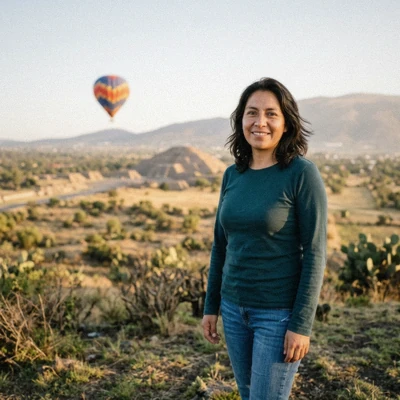
A hot air balloon flight over Teotihuacán is, for nearly everyone who books one, a calm and controlled way to watch the sun rise over the pyramids. This guide answers the safety question directly: what keeps a flight safe, what pilots and equipment are required to have, who the flight genuinely excludes, and what happens if something goes wrong mid-air. One question this guide does not answer is whether Mexico City or the wider region is safe to visit at all. That is a separate question about crime and political conditions, and the right source for it is your own government's official travel advisory system, such as the US State Department's four-level advisory ratings, not a blog post about ballooning.
Quick answer
A hot air balloon flight over Teotihuacán is safe for nearly everyone who books it. Pilots and balloons on these routes are certified by AFAC, Mexico's Federal Civil Aviation Agency, a ground crew tracks every flight from the launch field to the landing, and there are no reported passenger deaths on the Teotihuacán commercial sunrise flights that we could verify. It isn't risk-free, and it isn't for everyone. Pregnancy, some heart and back conditions, and a weight limit around 120 kilograms rule out a real share of travelers. The restrictions table below spells out exactly who should reconsider.
Key takeaways
- Pilots and balloons on Teotihuacán sunrise flights must hold AFAC certification, Mexico's Federal Civil Aviation Agency
- No reported passenger deaths exist on these specific commercial flights, though ballooning carries real risk elsewhere and always has
- Pregnancy rules out flying at any stage; a weight limit around 120 kg (265 lb) and a standing-only basket rule out others
- Operators call flights off, not you, once wind crosses roughly 15 km/h or rain and fog move in
- How you vet an operator before booking matters more than any single fact in this guide
- The full restrictions table, with what to ask before booking, is in the Who Shouldn't Fly section below
If Any of This Applies to You, Talk to a Doctor First
If you're pregnant
skip this flight at any stage of pregnancy, no exceptions across operators on this site
If you have a heart condition or high blood pressure
get your doctor's clearance before booking, given the cold pre-dawn start and the landing crouch
If you or a member of your group is near or over about 120 kg (265 lb)
call the operator directly before booking, since baskets are rated for a set total passenger weight
If you have a back problem or recent surgery
picture standing through a hard landing crouch before you commit
If you can't stand unassisted for 30 to 50 minutes
this flight isn't built for you, baskets have no seats
If you or anyone in your group has been drinking
reschedule instead, operators do not fly intoxicated passengers
The Safety Record: What We Actually Know
Ballooning is not risk-free anywhere in the world, and it never has been. Balloons have gone down in other countries and other decades, sometimes with real loss of life. That history is exactly why aviation authorities now require certification before a balloon can carry paying passengers commercially at all, and Mexico is no exception.
For the Teotihuacán sunrise route specifically, no official public fatality tally exists that we could verify, and across the operators and reporting we reviewed, there are no reported passenger deaths on these commercial flights. That is not a promise about the future. It reflects a route flown daily for years under AFAC oversight, launched only in the calmest hour of the day, with a chase crew tracking every basket from the ground.
The closest everyday comparison for the actual risk here is not the flight itself but the drive to reach it. Hotel pickup runs between 4:00 and 5:00 in the morning, followed by roughly 45 to 50 kilometers on a pre-dawn highway to reach the launch field before sunrise, and highway driving carries more real, measured risk per hour than a certified balloon flight does. You can compare the balloon flights we feature over Teotihuacan on our homepage.
What Makes a Flight Safer Here: AFAC, Licensed Pilots, and the Go/No-Go Call
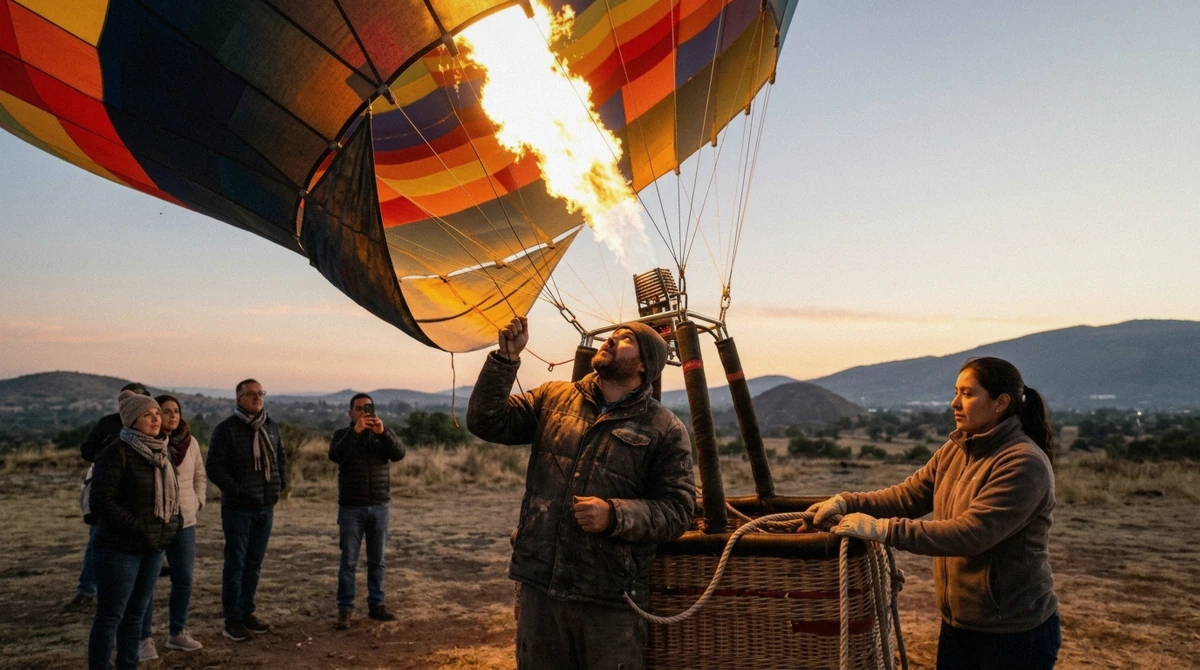
AFAC, Mexico's Federal Civil Aviation Agency, is the authority that licenses commercial balloon pilots and certifies the equipment they fly. A legitimate operator on this route flies a balloon and burner system that has passed AFAC inspection, with a pilot who holds a current commercial license rather than someone who learned informally and started charging for seats.
Every flight launches at dawn on purpose, between 6:00 and 7:30 in the morning, because that is the calmest, most predictable window for the air over the valley. Wind builds through the day, so a launch scheduled for mid-morning or afternoon would already be a warning sign rather than a convenience.
The go or no-go call happens on the ground, before liftoff, and it belongs to the pilot, not to you and not to a booking desk trying to avoid a refund. Once sustained wind crosses roughly 15 kilometers per hour, or rain, thunderstorms, or dense fog move in, the flight is rescheduled rather than flown. A cancelled flight is the safety system working as intended, even though it feels like a letdown when you're standing in the cold at 5:30 in the morning.
A ground or chase crew follows the balloon by vehicle for the entire flight and is waiting at the landing field when it comes down. That crew is also what makes a fast response possible if one is ever needed, since nobody is relying on a phone call from an empty field to know where the balloon landed.
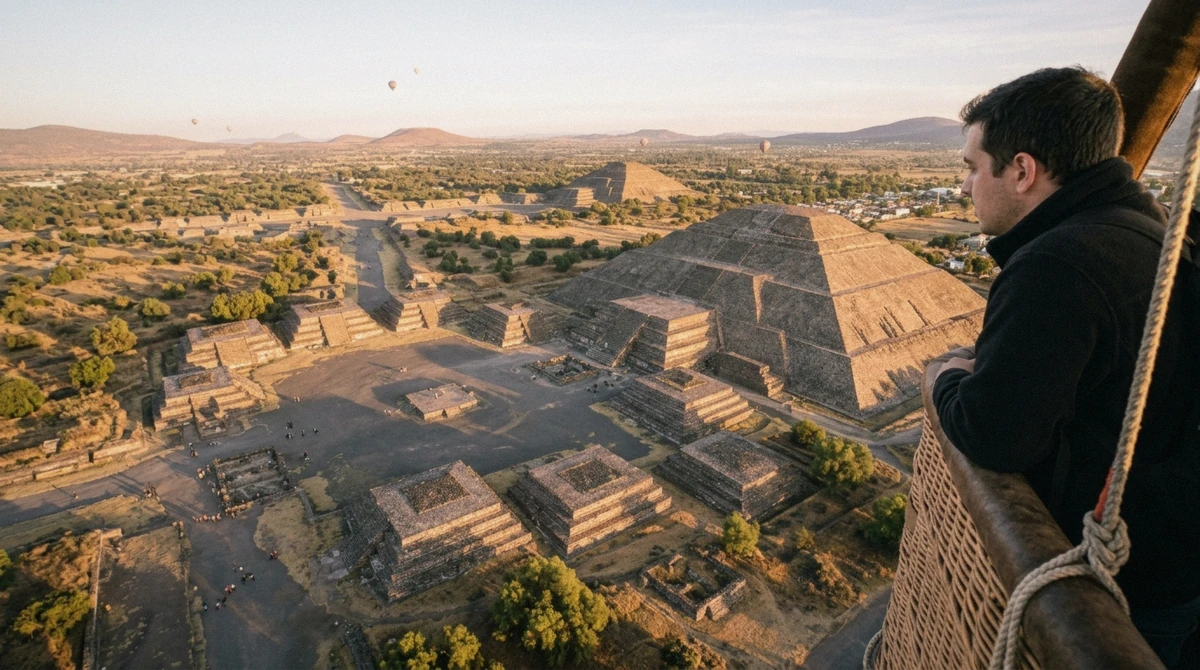
The Real Risks and How Good Operators Manage Them
Beyond the headline question of whether anyone has died on this route, four things can actually go wrong on an otherwise well-run flight, and each has a specific mitigation, not a vague reassurance.
A hard landing is the most common real event, not a crash, just a firmer touchdown than the gentle glide operators aim for when wind at ground level shifts in the last few minutes. The mitigation is procedural: the pilot briefs the landing crouch, knees bent, hands on the internal handles, well before descent begins, and the chase crew is already positioned at the field to steady the basket the moment it lands.
A gust that shifts the balloon off its expected path is normal, not an emergency, because the pilot only ever controls altitude, catching different wind layers to steer roughly toward a landing field, never the direction itself. That's also why the balloon lands somewhere different every morning. The chase crew tracks it by radio and vehicle for the entire flight, so a course change never leaves anyone stranded or unaccounted for.
The propane burner sits directly above the passengers' heads and throws real heat when the pilot fires it to climb, enough that a stray hand near the controls could get burned. Only the pilot operates the burner, passengers are briefed to stay clear of it before liftoff, and basket design keeps the flame arc above head height rather than at passenger level.
There is nowhere to sit. Baskets are built for standing passengers only, and thirty to fifty minutes on your feet at dawn, cold and a little lightheaded from the early wake-up, catches some travelers off guard. The basket itself helps: internal compartments with waist-high walls to lean against, and a flight length capped well short of an hour specifically so fatigue doesn't become a factor.
| Situation | What a good operator does | Warning sign |
|---|---|---|
| Wind builds faster than forecast mid-flight | Pilot begins descent early and picks the nearest safe field rather than chasing the planned route | An operator that keeps flights airborne past its own stated wind cutoff from the launch field |
| The landing field turns out rough or sloped | Pilot repositions toward flatter ground and repeats the crouch briefing on the way down | A crew that skips the landing briefing entirely, or briefs it once, hours earlier, at pickup |
| A passenger reports feeling unwell at altitude | Pilot shortens the flight and descends at the nearest safe field rather than finishing the route | Staff who wave off a medical concern raised at check-in instead of noting it before boarding |
How to Choose a Safe Balloon Operator in Mexico City
AFAC certification and a calm dawn launch are the baseline, not proof that any single operator runs a careful trip. The rest comes down to what you can see and ask before you climb into a basket.
- A full safety briefing on the ground before boarding, covering the landing crouch and where to hold on
- A visible chase or ground crew vehicle at the launch field, not just at hotel pickup
- Staff who ask about your weight, health conditions, and pregnancy status as a normal part of check-in
- A calm, unhurried boarding process rather than a rush to fill the basket before sunrise
- A clear cancellation and refund policy stated up front, not buried in the fine print
The opposite behaviors are worth walking away from:
- A waiver you're asked to sign quickly, without real time to read it
- Staff who say something close to we'll squeeze one more in when the basket is already full or the weather looks marginal
- No safety briefing at all before boarding
- Pressure to fly after you've disclosed a weight, pregnancy, or health concern that should exclude you
- An inability or unwillingness to say who the pilot is, or confirm the balloon is AFAC-certified, when you ask directly
One practical note that has nothing to do with the flight itself: theft is a low risk on a guided tour with a known group and a crew, but the exposure point is an unattended bag at pre-dawn pickup or left in the vehicle during the flight. Keep your phone on a wrist strap in the basket, since a dropped phone from altitude is simply gone, and leave anything you'd hate to lose in the hotel room rather than the vehicle.
Two operators on this site make that vetting easy because they publish the details rather than making you ask. The Sunrise Balloon Flight with Cave Breakfast is the best-seller here and the most reviewed, with more than seven thousand ratings that include plenty of comments on how the crew handled a bumpy morning. If a smaller group matters more to you than review count, the award-winning small-group flight caps at fifteen passengers instead of the fifty on the larger tours, which means a shorter, calmer boarding process and a pilot who can brief a smaller group directly.
For the lowest price on this site without cutting the safety basics, the top-rated flight with La Gruta cave breakfast and a pyramids walk carries a perfect 5.0 rating across its reviews.
Who Shouldn't Fly: Restrictions at a Glance
Every restriction below comes from what operators on this route actually enforce, not a guess. Two are worth double-checking before you pay: the maximum weight, since some operators add a surcharge before they reach their hard cutoff, and the standing requirement, since none of these flights offer a seated option.
| Restriction | Typical rule on Teotihuacán tours | Why it exists | Ask before booking if… |
|---|---|---|---|
| Pregnancy | Excluded at any stage, no exceptions | The standing position and the possibility of a hard landing both carry a fall and impact risk the flight can't control for | you are pregnant, at any point in the pregnancy |
| Minimum age | Around 5 years old on most tours, some set it at 4 or 6 | A child needs to be tall enough to see over the basket edge and able to hold the landing crouch | you're traveling with a child under about 6 |
| Maximum weight | Around 120 kg / 265 lb per person; some operators allow up to 135 kg, with a surcharge often starting around 100 kg | Basket lift and fuel are calculated against a safe total passenger weight, and going over that changes how the balloon flies | you or anyone in your group is near or over 100 kg / 220 lb |
| Heart condition or high blood pressure | Not advised without a doctor's clearance | The cold pre-dawn start, the altitude, and a hard-landing crouch all add brief cardiovascular strain | you manage a heart condition or take blood pressure medication |
| Back problems or recent surgery | Not advised | The landing crouch and an occasionally firm touchdown both load the lower back and any healing incision | you've had back surgery or a flare-up in the past few months |
| Ability to stand for the full flight | Required, no basket on this route offers a seated option | Weight distribution and the landing brace both depend on every passenger standing and stable | a mobility issue would make standing for 30 to 50 minutes difficult |
| Alcohol or intoxication | Not permitted before or during the flight | The landing crouch needs coordination and a quick response to the pilot's instruction, and a balloon can't pull over | you or a member of your group has been drinking before pickup time |
None of this is enforced by eyeballing you at the launch field. It's built into what you confirm when you book, so the honest move is to answer these questions accurately rather than rounding your weight down or leaving out a heart condition to avoid an awkward conversation.
What If Something Goes Wrong: Four Scenarios, Honestly
The flight is cancelled the morning of
What happens: the pilot makes the call against wind, rain, or fog before liftoff, sometimes before you've even left the hotel. What the operator does: a legitimate operator contacts you before roughly 5:30 in the morning and offers a new date or a full refund, with many honoring a reschedule window of up to 90 days. What you do: book through an operator with free cancellation inside 24 hours, so a weather call costs you nothing either way.
The full mechanics of weather cancellations, and how the refund actually works, are in our guide to flights cancelled for weather.
The landing is rougher than the gentle glide you pictured
What happens: a shift in ground-level wind in the final minutes turns what should be a soft touchdown into a firmer one. What the crew does: the pilot has already briefed the landing crouch before descent begins, and the chase crew is standing at the field to steady the basket the instant it lands. What you do: hold the internal handles, keep your knees bent through the crouch, and stay in position until the pilot says it's safe to move, rather than climbing out early.
Someone in the basket starts feeling unwell at altitude
What happens: the early wake-up, the cold, and standing for the first time in a swaying basket can leave a passenger lightheaded, far more often than any real medical event. What the crew does: the pilot can shorten the flight and descend at the nearest safe field rather than finishing the planned route, and the chase crew reaches the landing point by vehicle within minutes. What you do: say something immediately instead of pushing through it quietly, and disclose any condition, however minor it feels, when the operator asks at check-in.
You disclosed a weight, pregnancy, or health concern and the operator says no
What happens: a properly run operator declines to board a passenger who falls outside its stated restrictions, even at the field, even if it makes for an awkward conversation. What the operator does: a good one offers a refund or reschedule rather than quietly letting the issue slide to fill the basket. What you do: this is the one safety lever that is genuinely yours to pull.
Book with an operator that asks these questions honestly at check-in, and answer them honestly yourself, rather than one that skips the conversation to avoid losing a sale.
Frequently Asked Questions
What happens if the weather turns bad on the morning of my flight?
The pilot makes the go or no-go call before liftoff, against wind, rain, or fog, and a legitimate operator contacts you before roughly 5:30 in the morning with a new date or a full refund. Book with free cancellation inside 24 hours so the weather call never costs you anything. Full detail in our guide to flights cancelled for weather.
Has anyone died on a hot air balloon flight over Teotihuacán?
No official public fatality tally exists for these commercial sunrise flights that we could verify, and there are no reported passenger deaths on this specific route. Ballooning as an activity is not risk-free anywhere in the world, which is exactly why AFAC certification, licensed pilots, and a dawn-only launch window exist in the first place.
Can I fly in a hot air balloon while pregnant?
No. Pregnancy excludes flying at any stage across the operators on this site, because the standing position and the chance of a hard landing both carry a fall and impact risk the flight can't control for.
What is the weight limit for the Teotihuacán balloon flights?
Around 120 kg (265 lb) per person on most operators, with some allowing up to 135 kg. A weight surcharge often starts around 100 kg. If you or anyone in your group is close to that line, call the operator directly before booking rather than finding out at the field.
What is the minimum age for a hot air balloon flight over Teotihuacán?
Around 5 years old on most tours, though some set it at 4 or 6. The real requirement is that a child be tall enough to see over the basket edge and able to hold the landing crouch, not just meet a number.
Is it safe to fly with a heart condition or high blood pressure?
Not without a doctor's clearance first. The cold pre-dawn start, the altitude, and a hard-landing crouch each add brief cardiovascular strain, small for most people but worth checking with a doctor if you manage either condition.
How can I tell if a balloon operator is properly certified?
Ask directly whether the balloon holds AFAC certification and whether the pilot carries a current commercial license. A legitimate operator answers plainly; one that dodges the question, rushes your waiver signature, or talks about squeezing one more passenger in during marginal weather is a red flag to book elsewhere.
How does 'is the balloon flight safe' differ from 'is Mexico City safe'?
They're two different questions with two different answers. This guide covers the activity itself: certification, pilots, weather calls, and who shouldn't fly. Whether Mexico City or the wider region is safe to visit at all is a question about crime and political conditions, and the right source for that is your own government's official travel advisory system, such as the US State Department's four-level ratings, not a blog post about ballooning.
A hot air balloon flight over Teotihuacán is safe for nearly everyone who books it, backed by AFAC certification, a dawn-only launch, and a ground crew tracking every basket. It is not safe for everyone, and the restrictions above, pregnancy, the weight cap, standing for the full flight, are not fine print. They're the actual line between a calm sunrise and a flight you shouldn't take.
If you're still deciding whether the early wake-up and the cost are worth it at all, our honest read on whether a balloon flight is worth it covers that separately. Curious what you'll actually see once you're airborne, pyramids included or not? Read what flying over the pyramids really looks like.
And if a weather call is what's holding you back from booking, here's exactly what happens when a flight gets cancelled. When you're ready, compare the sunrise balloon tours near Mexico City and pick the operator whose answers to the questions above you actually trust.